
Watershed Watch

Watershed Watch is one of Idaho's longest-running community science events. Every fall, this one-day event connects over 400 upper elementary students with water quality testing, water science and our local watershed.
Each class is assigned an accessible site along the Boise River and is guided in hands-on environmental science activities by water professionals from one of our partner organizations. Students wade into the water to test the chemical, physical and biological health of the Boise River and share their data with the public.
Please contact us if you have questions about the program.
The next Watershed Watch will take place on Sept. 17, 2026.
Contact UsWatershed Watch Data
Click through the Watershed Watch testing sites on the map to view the most recent data as well as data trends or download the data as a spreadsheet.
How-To Videos

Lesson Plans
Is the Boise River Healthy?
Explore the Boise River virtually through videos and worksheets below to assess the health of the Boise River.
Materials
Student Worksheet (PDF) | Student Worksheet (Word Doc)
HomeWeek 1: Water Management with the City of Boise
Water Management Stakeholders | Helpful Links | Activities

Water Management on the Boise River is incredibly complex. There are numerous people and groups that need to use the water in the river, want to recreate, want to keep the river pristine, are in charge of the health of the organisms that live in the water, and all sorts of other things. These people that rely on and use the Boise River are called Stakeholders. Stakeholders can be organizations, governments, groups and even individual people. Even YOU are a stakeholder on the Boise River! Below, we have listed several the stakeholders on the river so that you can see how many entities contribute to the protection and management of the Boise River.
Water Management Stakeholders
Cities
Cities like the city of Boise, Eagle, Caldwell, Nampa, Parma, and more, are all in the Boise River Watershed and they all need to use the water in the river. These cities have engineers, water quality scientists, and other staff who work on keeping the river clean and usable. Also, these cities collect used water from our homes and businesses, clean it, and put it back into the watershed.
Dam Managers
These are the people who build and operate the dams in the Boise River.
Have you ever wondered who built all the dams on the Boise River? The U.S. Bureau of Reclamation is the government entity that builds a lot of our dams! They oversee and built Anderson Ranch Dam and Arrowrock Dam in order to control the water in the Boise River. They help make sure that there isn’t too much flooding in the spring and that our farmers and cities have water in the late summer.
The Army Corps of Engineers is a group of engineers from the US Army who do engineering work all over the world. They built and maintain Lucky Peak Dam and Powerhouse. The power generated at the dam is owned by Seattle City Light, the company that provides people in Seattle their electricity. Crazy! That means people living in Seattle are also stakeholders on the Boise River.
Another entity which works with the dams and with the canals and irrigation that run through our watershed is the Boise Project Board of Control. They help monitor and manage the water that is used by irrigation.
Drinking Water
Drinking water in the Boise River Watershed usually comes from ground water sources. However, that ground water is recharged by the Boise River and by the irrigation that happens in the spring, summer, and fall. In fact, thanks to leaky irrigation systems, we have more groundwater access now than we did in before we started irrigating the arid land in the Treasure Valley. In Boise, a French company called Suez oversees providing people water. In the other cities, they may have a company or district that provides water, or they do it as a city. Some people have wells which let them pull up ground water directly into their homes.
Farmers and Ranchers
Farmers and ranchers in the Boise River Watershed need to grow crops and raise animals with the water from the Boise River. The dams help store water so that they can have access to water even in the late summer.
Wildlife Management Agencies
Agencies like Idaho Fish and Game and the US Fish and Wildlife Service are working on the river to make sure that all the fish and animals that rely on the river can maintain healthy populations.
Industry
Many Businesses operate in the Boise River Watershed area. A lot of these Businesses need water to create their products or services. Businesses like Micron, Simplot, HP, and other big businesses are ones that we know. However, there are many small, local businesses that have been in the Boise River Watershed for a long time that rely on the water from the river.
People
People like you rely on having a clean river. Whether you drink water, like to swim or raft, like to boat in Lucky Peak Reservoir, or more, you are a stakeholder in your watershed.
Some Helpful Links
Water Management Activities - Week 1
Activity 1: Dam it up!
We want you to experiment with how dams hold back water. Find an adult to help you get the materials to build a beaver dam in a box. Experiment with different materials and objects to see which ones hold back the water the best.
You can find a video of how to do the experiment here
Be sure to take some pictures and send them to us at WaterShed@CityOfBoise.org so that we can share them on our social media.
Activity 2: To dam or not to dam?
We want you to research and form your own opinion about dams in the west. There is a lot of information about how dams affect ecosystems and recreation where we live. They also can provide clean energy. Some people think that we should take out dams on the Snake River (which the Boise River feeds into). Other people think that we should invest more into the benefits that dams might provide. Do some research online and find multiple sources. Then, write a persuasive paragraph in support of or against dams in the West.
Activity 3: Irrigation and water quality, let’s fix it!
When we irrigate crops and lawns, excess water runs off into the rivers and streams in our watershed. Farmers and managers work very hard to make sure that the fertilizers and chemicals they use don’t go into our water, however, they can’t stop everything, and these non-point source pollutants will sometimes end up in the Boise River. Your challenge is to do some research about pollution found in runoff from cities and farms and then engineer a plan to help reduce the amount of pollution getting into our rivers. You can draw out your plan, make a video, make a model, or whatever you want to use to communicate your plan. You can send pictures and videos of this engineering challenge to WaterShed@CityOfBoise.org.

Temperature
The temperature of the Boise River is an important indicator of health. When temperatures get too warm, it increases the likelihood of harmful algae blooms, chemical reactions, and is dangerous for fish. Scientists monitor the temperature in the river constantly. This data helps us learn what normal temperatures should be and can show us where there might be problems in the river. Temperature is measured in °C or °F. The following graph shows temperature over a few days on the Boise River near Caldwell, ID. Notice that the temperature changes during the night and day times. Temperature is usually measured with a thermometer.
Turbidity
Turbidity is a measure of water’s lack of clarity. It is used as an indicator of water quality. Certain aquatic organisms cannot survive if the turbidity is too high. Turbidity is measured in NTUs (Nephelometric Turbidity Units). If the river has high turbidity, that means that there are a lot of particles floating in the water. These particles can be things like soil, organic matter, chemicals, salts, nutrients, and more. Some rivers naturally have high turbidity, like the muddy Mississippi River. Organisms in high turbidity rivers have adapted to living in those environments. Other rivers have lower turbidity. These rivers, like the Boise River, are usually filled with cold, clear water and organisms in them are adapted for those conditions.

A secchi disk is a special black and white disk on a string that you can lower into water until you cannot see it. Once you cannot see it, you slowly pull it up until you can barely see it, then measure how deep the secchi disk went into the water. Multiply this number by 2 and then you will know how far light is penetrating the water.
Check out this video to see a secchi disk in action!
What about testing flowing water? In rivers, we can’t always lower a secchi disk into the water so we must use a turbidity tube, which is a plastic tube you can fill with water, and it has a secchi disk at the bottom. Another method is to use a device called a spectrophotometer; these are generally used when a scientist needs to know what kind of light a sample of water is absorbing.
Temperature and Turbidity Activities - Week 2
Let’s complete some temperature and turbidity challenges!
Challenge 1:
Look at the two pictures below. One picture shows a river with 4 NTUs in turbidity, the other river has a measured turbidity of 80 NTUs.

The Big Muddy River in Illinois

The Boise River in Idaho
How can you tell which river has 4 NTU measured turbidity, and which river has 80 NTUs of measured turbidity? What types of adaptations would animals in the Big Muddy River need to have to survive? What types of adaptations would animals in the Boise River need to have to survive?
Challenge 2:
Find a good temperature and turbidity habitat for Idaho fish.
Some fish like to live in cold water, and some can live in warmer water. There are many types of fish that live in the Boise River. Let’s look at three of them and some of their temperature and turbidity preferences.

MOUNTAIN WHITEFISH

RAINBOW TROUT

BLUE CATFISH
Now that you have an idea about what some Idaho fish need to live healthy lives, let’s look at some of the data collected from the Boise River this summer. The following data shows the temperature measurements and the turbidity measurements from the beginning of the lower Boise River Watershed to the end of the Boise River where it runs into the Snake River. The site codes are labeled on the graphs and you can see where they are located with the Watershed Watch Map.
Think about which sites offer ideal temperature and turbidity for each of the fish species.


Challenge 3:
We want you to go to the river and discover some temperature and turbidity. If you can’t get to the river, that is ok! We have a link you can follow that will show you a video of the river and you can answer the same questions.
Use this river video if you can’t get to the Boise River for observations.
Question 1:
Is the water that you are looking at clear (low turbidity) or murky (high turbidity)? How can you tell?
Question 2:
If you put your hand in the water (or imagine putting your hand in the river) does it feel warmer or colder than the air? Why do you think it is colder than the air?
Question 3:
Does the water you are looking at seem healthy? Why or why not?
Our world is more connected than ever. We send planes, ships, products, people, and animals to new countries and new places every day. One of the consequences of this connectivity is the introduction and the spread of invasive species. Invasive species are plants, animals, or pathogens that are brought to a new area and harm other plants and animals. Often, they overtake and “invade” areas that historically were occupied by native or more beneficial species.
We talk a lot about invasive species in Idaho because we live in a state with vast natural resources. These natural resources (think: water, timber, minerals, and more!) are the economic core of our state. What protects our natural resources are healthy ecosystems. Healthy ecosystems clean our water, grow resources, clean our air, protect us from flooding, and more. These benefits of healthy ecosystems are called ecosystem services. When an invasive species is introduced into a healthy ecosystem, it can (and often will) overtake the ecosystem. Invasive species will replace the native and non-invasive species and inhibit the ecosystem’s ability to provide ecosystem services. Idaho’s ecosystems are in a constant battle to fend off invasive species, and they cannot do so without our help!
Familiarize yourself with some common invasive species you may find in the Boise River Watershed, in the photos below.
Invasive Species in the Boise Watershed

Yellow Flag Iris

Purple Loosestrife

Common Reed

Eurasian Watermilfoil

Parrotfeather Milfoil

Flowering Rush

Zebra Mussel

Quagga Mussel

New Zealand Mud Snail
What can you do?
What can you do?
There are a lot of things that we can do to prevent the spread of invasive species in Idaho. The best place to find information on invasive species is the Invasive Species of Idaho webpage: invasivespecies.idaho.gov.
There, you can look up different invasive species and find information on how you can help control them based on your interests. Here are some examples:
- When you visit outdoor spaces, make sure you clean your boots, clothes, and pets. Invasive weeds and seeds can hitch a ride on you and your pets.
- When you purchase plants online, make sure they are native species to grow in our region.
- If you go fishing or camping near water, make sure to clean off your gear.
- Do not transport firewood long distances.
- Never release pets into the wild.
As someone who lives in the Boise River Watershed, being on watch for suspicious looking plants and critters is extremely valuable for the invasive plant managers in the state. When you find an invasive species or something that might be invasive, you can take pictures of it, and contact the Idaho Invasive Species Hotline 1-877-336-8676, or visit invasivespecies.idaho.gov/contact to find someone in your area who can help.
Invasive Species Activities - Week 3
Activity 1: Identify some invasive species:
Look at the following pictures of invasive species and try to identify them with the help of invasivespecies.idaho.gov.
(Answers are provided at the bottom of this section)

A.

B.

C.

D.

E.

F.
Activity 2: Research an invasive species
Find and invasive species in Idaho and answer the following questions:
- What is it called?
- Where is it from, originally?
- How does it move to new areas?
- What does it do to healthy ecosystems?
- How can we manage it
Activity 3: Search for invasive species in the Boise River Watershed
Spend some time searching for invasive species in the Boise River Watershed. Remember to search safely, do not go too close the river and do not touch plants that appear prickly and unsafe.
If you think you have found an invasive species, the best thing to do is:
- Record its location
- Take pictures of it
- Call the Invasive Species Hotline 1-877-336-8676.
Answers to Activity 1:
A. Poison Hemlock | B. Giant Hogweed | C. Yellow Floating Heart | D. American Bullfrog | E. Red Eared Slider | F. Hydrilla
Week 4: Organisms in the River with the City of Boise
Scientists spend a lot of time figuring out the best way to test water to see if it is healthy. They can test physical parameters like temperature and turbidity (how clear is the water), and chemical parameters like pH and dissolved oxygen in the water. In water bodies that move very slowly like lakes and ponds, these physical and chemical parameters are very important. In water bodies that move more quickly, like rivers and streams, physical and chemical parameters are still important, but scientists need to look at other factors too. Since the water they are testing is constantly moving downstream, they need to utilize living things that do not, or cannot, move very far in the water body to get an idea of the water quality over time. These living things are biological parameters that we consider bioindicators. This means that we can use what we know about these organisms to help us understand the water quality in a river or stream over time. Scientist can use plants that grow in water or periphyton (the slimy stuff growing on the bottom of streams and rivers) as bioindicators, but today we are going to talk about bioindicators called macroinvertebrates.
Macroinvertebrates
The term “macroinvertebrate” or “macro” for short, is used to describe any living organism that you can see with the naked eye (macro) and does not have a backbone (invertebrate). In rivers and streams, macroinvertebrates come in many different forms. Some of those forms are Insects, Mollusks, Crustaceans
Insects

Stonefly Nymph

Mayfly Nymph
There are many different insects that live in the Boise River. A lot of these insects spend a large part of their lifecycle under water. Some of these insects live their entire life under water. When we are looking for insects in the Boise River, we are trying to find organisms life mayfly nymphs, caddisfly nymphs, or stonefly nymphs. These nymphs are very sensitive to pollution so when we find them, it indicates good water quality. Other insects we can find are different beetles, mosquito larva, and more.
Mollusks

Freshwater Pearl

Snails
There are many mollusks that can live in the Boise River. Mostly these mollusks are types of snails and mussels. Some native mussels can be incredibly rare and valuable for our river’s water quality since they can filter up to 15 gallons of water each day!
Crustaceans

Crayfish

Scud or Amphipod
Crustaceans are an important part of the Boise River Watershed. They consist of the crayfish and the amphipods that live in our waterways.
Activities for Week 4
River Organisms Activities - Week 4
Activity 1: Research a Macro
Look up a macroinvertebrate that lives in the Boise River. Answer the following questions about the macro:
- How big is the macro?
- What does the macro eat?
- Where does the macro like to live?
- Is the macro sensitive to pollution?
- What is the name of the macro?
Activity 2: Make your own Macro
It is fun to think about crazy designs, but you also want to think about the science behind macros and what features could make your macro successful in an aquatic environment. Plan out your macro with the following questionnaire and then draw or paint it.
- Where do you want your macro to live?
- What do you want your macro to eat?
- How will it catch or get its food?
- How big is your macro?
- What color is your macro?
- How will your macro defend itself?
- What is the name of your macro?
Be sure to send us copies of your macros WaterShed@CityOfBoise.org so that we can see them!
Activity 3: Use an index to determine water quality
At the Boise WaterShed Education Center, we have developed a simple index so that you can perform biological testing on the river. We want you to go out to the river (always go with an adult) and see what you can find. Watch the informational video here and use our River Macro ID chart to help identify macros and to help determine the water quality in the Boise River.
If you cannot get to the Boise River, that is ok! Below you can find different macro samples taken from two different rivers and you can use the River Macro ID chart to determine which one is the healthiest and which one may have some pollution in it.
Week 5: Nutrients with the City of Boise
Eutrophication | Measuring Nutrients and Contaminants | Activities
Nutrients are an important part of life. They provide the nourishment that living things need to thrive. In river ecosystems, they are essential for the wellbeing of the organisms. Plants, animals, bugs and microbes all need nutrients. Two of the most common and important nutrients that can be found in water systems are phosphates and nitrogen. Phosphorus (phosphates) is a chemical element that is essential for life. It is a key part of DNA. Nitrogen (nitrates) is a highly abundant element that is also essential for life. Both of these nutrients are found in our own bodies and all around us. In river ecosystems, there are always phosphates and nitrates. However, scientists are constantly testing for these nutrients since too many phosphates and nitrates can be a source of pollution in our rivers.
Eutrophication
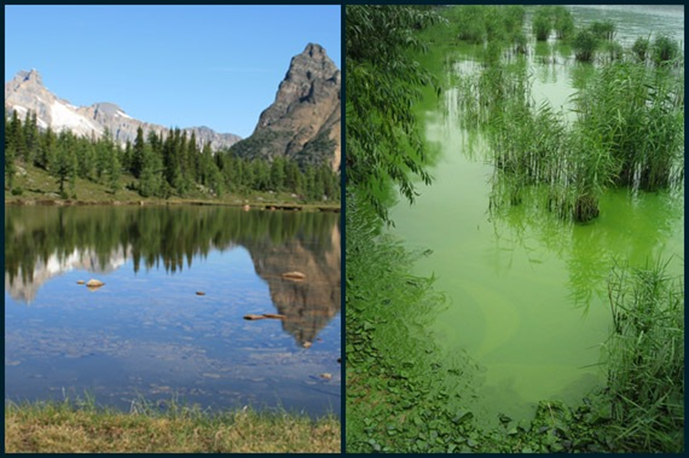
When there are too many minerals and nutrients (like phosphates and nitrates) in the water, it speeds up a process called eutrophication. Eutrophication is when bodies of water have excess nutrients. These excess nutrients cause algae to grow rapidly in the water. The water can become green, smelly, and eventually it could kill many of the organisms that are living in the water body. Some water bodies are in a process called natural eutrophication; places like swamps and ponds are eutrophic and that is the way the ecosystem is supposed to be. Many water bodies like lakes and streams, are not naturally eutrophic. Unfortunately, people sometimes add pollution in the form of nitrates and phosphates that put water bodies through a process called cultural eutrophication. This means that water bodies which shouldn’t be eutrophic are becoming eutrophic due to human pollution.
Measuring Nutrients and Contaminants
In the Boise River Watershed, scientists are constantly checking the amounts of nutrients that are in the water. This information can help them understand what kind of pollution we might be adding to the Boise River and what we might have to do to minimize our effect on the water quality. Additionally, high levels of nutrients can lead to harmful algae blooms. These harmful algae blooms consist of cyanobacteria (blue-green algae). Cyanobacteria are actually a bacteria that can photosynthesize like algae. These bacteria can be incredibly poisonous to humans and animals, which is another reason why we want to make sure the nutrients in our water bodies are controlled.
Nutrients Activities - Week 5
Activity 1: Search for eutrophication using Google Earth.
See if you can find examples of eutrophication on Google Earth. A great way to look for signs of eutrophication is to look at satellite images of bodies of water. These images can often show algal blooms and green water. Look up at least three lakes or rivers and compare the way the water looks. Make sure to vary the location of the bodies of water that you look up, try and find ones close to human civilization and ones further from human influences.
Activity 2: Search for phosphates in your home.
In order to minimize the impact of phosphates, we need to stop using so many of them in our homes. Do a phosphate audit of some of the products you have in your house. A good place to look for phosphates is in cleaning products and some personal care products. Phosphates can also be found in some foods. Usually, phosphates are labelled on the ingredients list of the products label. They can be written as orthophosphates, pyrophosphates, polyphosphates, and others, but usually will have “phosphate” in the name. After you have identified some products that contain phosphates research some phosphate free alternatives that you can use in your home.
Activity 3: Let’s look at some data!
The following graph shows total phosphorus data from the Boise River this August. Look at the graph and answer some questions below:
Use the Boise Watershed Site Map (near the top of this page) to help answer questions about this graph.
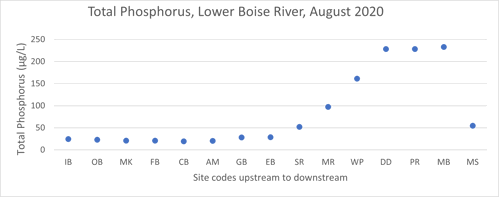
- How does the amount of total phosphorus change as we move down the Boise River?
- Why do you think that change happens?
- What are some of the problems that might happen due to high levels of phosphorus in the lower Boise River Watershed?
- What are some ways we could lower the amount of phosphorus in our river?
We often think about engineering devices, buildings, and electronics, but we rarely think about how environments (especially ones with a lot of humans in it) need to be engineered for the safety and health of humans and nature. Environmental Engineering is a branch of engineering which focuses on improving the environment and protecting people from pollution, flooding, and more! Since so many people live around the lower Boise River, there are a lot of Environmental Engineers who work on the river for us.
Like scientists, engineers must be smart, and ready to tackle challenges. Instead of focusing on observations and discoveries, engineers are the people who create solutions to our challenges. They rely on scientists to provide them with good information so that they can create effective solutions. Engineers use the Engineering Design Process to create solutions to problems. Check out the engineering design process below:

The Engineering Design Process
Define the problem
Figure out what issue you are trying to solve! Write it out clearly so you know exactly what needs to be fixed.
Plan solutions
Engineers spend a lot of their time writing down and planning solutions. Before committing to a specific solution, you need to make sure that it is the best one! This requires a lot of time and research.
Make a model
Engineers can’t create a solution without building a model of it first! Types of models include diagrams, drawings, physical replicas, mathematical representations, analogies, and computer simulations.
Test a model
Testing your model is one of the most important steps of the engineering design process. Make sure to record everything and take notes.
Reflect and Redesign
Take what you know and design the best solution possible, if you must go back to the beginning of the process, that is great! Engineers are always refining and redesigning their work.
Environmental Engineering Activities - Week 6
Activity 1: Build a paper bridge challenge
Engineers generally must work within parameters. This means that they only have so many resources available to design a solution. We are going to give you an engineering challenge with set parameters. Your goal is to build a sturdy bridge that crosses at least 8 inches. You can create a valley or space to cross by using books, chairs, tables, etc. It may sound easy, but you can only use ONE piece of paper to build this bridge, and it needs to be able to support the weight of at least 50 pennies (or 125 grams if you don’t have pennies). Good luck and remember to use the engineering design process to help you complete this challenge.
Activity 2: Design an engineering solution for the Boise River
Throughout Watershed Watch you have learned about some of the impacts humans have on the Boise River. One of the biggest impacts is the stormwater that flows from the streets of cities into the river. This challenge is going to ask you to do two things. Firstly, research stormwater and its impacts on rivers. Some good local resources are the Partners for Clean Water and the Idaho Department of Environmental Quality. Next, develop a plan for how cities can minimize stormwater impacts. Make sure to write out details and draw out what your plan would look like. If you can, build a model of your plan.
Activity 3: Environmental Engineering search
Go outside and search for some examples of environmental engineering. We are not as trained to see environmental engineering as we are other types of engineering but look for places that have erosion control (Tip: You’ll see this near a construction site.), stormwater drains, parks, flooding controls, paver parking lots, swales, etc. Write down some of your observations so that you can catalog different types of environmental engineering.
Week 7: Rules and Regulations with the Department of Environmental Quality
Protecting Clean Water | Activities
Before the mid-1900s, people dealt with pollution differently than today. In the USA and in Idaho, it was common practice to put used chemicals, human waste, waste from industry, and more into rivers or lakes. Due to this practice, our freshwater systems became some of the most polluted places in the world. In Idaho, the Boise River was so dirty that people downstream from Boise could not fish or swim in the river and many of the river organisms were dying. In the rest of the United States, rivers like the Boise River were extremely polluted. People knew that something had to be done about pollution in the water. In Boise, the League of Women Voters got together and raised funds to build the Lander Street Water Renewal Facility. This facility would treat used water from the city before releasing it back into the Boise River. It was built in 1949 and is still operating today!
Protecting Clean Water
In the rest of the country, people were getting concerned about pollution in water. On June 22, 1969, the Cuyahoga River in Cleveland, Ohio caught on fire due to the amount of pollution floating on its surface. This fire gained national attention and inspired the creation of the Clean Water Act of 1972. The Clean Water Act has gone through many updates and changes in the last 50 years but simply put, it is a law that sets pollution limits for things discharged into water bodies. It also sets limits for how healthy water bodies need to be in the USA. The Clean Water Act, along with other regulations, is monitored by the Environmental Protection Agency (EPA) and state-run departments. In Idaho, the Department of Environmental Quality (DEQ) is the entity that monitors rivers and lakes to make sure that Idaho follows the Clean Water Act. If an organization or community thinks they need to discharge water back into rivers or lakes, they must apply to the EPA for a National Pollutant Discharge Elimination System (NPDES) permit. When they apply for this permit, they will clearly show the ways they will clean the water before discharging it back into water bodies in order to avoid polluting the water. After they receive the NPDES permit from the EPA, then they can start discharging reclaimed water into water bodies. In Idaho, the DEQ monitors all of the NPDES permit holders to make sure they are keeping their promise to protect the waters in our state. In the USA our goal is for everyone to have “fishable, swimmable, and touchable” water.


Rules and Regulations Activities - Week 7
Activity 1: Take a virtual tour of the West Boise Water Renewal Facility
Join one of the Boise WaterShed’s staff as they take you on a tour of the West Boise Water Renewal Facility and show you how the city of Boise protects the Boise River and meets its NPDES permit requirements.
Watch the tour video here
Activity 2: Make a regulation
Creating regulations is a difficult process. Often, groups that oversee the creation of regulations must juggle what is good for the health of the river, what is good for the economy, and what is good for the people that rely on the river. For this activity, take some time to think about a problem that you want to fix on the Boise River. It could be the amount of trash, the smell, the pollution in the river, anything that matters to you. Finally, take some time to create a regulation that would help solve the problem. Answer the following questions:
What is the problem you want to fix?
Why is it important to you?
Why is it important to people who live in the Treasure Valley?
What regulations would you create to fix the problem?
What agency(s) or organization(s) would oversee monitoring and enforcing your regulation?
Activity 3: Think of the River!
We know that there are organizations and groups that are regulating and protecting the river from pollution, but how can you help protect the river? Use the link below and look at the suggested actions which can lower the amount of pollution that you create. Try and complete one of these actions so that you can be an active protector of our water quality!
Our water and our used water go through many processes. We want to make sure that we have enough water for human uses as well as water for the organisms that rely on the river. Additionally, we need to make sure that the treated water going back into the river (called effluent) from a wastewater treatment facility is going to support the ecosystem and downstream communities rather than pollute them. There are several water quality labs in the Treasure Valley that test many types of water to check water quality. We are going to share with you a few parameters they test for and then ask you to complete some activities based on lab analysis.
Things labs test for in the Boise River and in our reused water:
E. coli
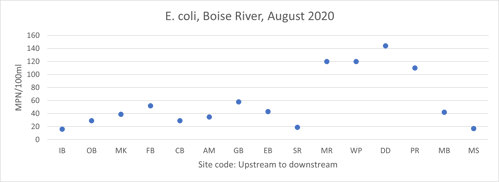
E. coli is a type of bacteria that lives in the guts of humans and animals. Most of the time, it is harmless. However, certain strains of the bacteria can make people and animals sick. There is E. coli and other coliforms that are found in the river, but if the numbers are low enough, people are usually safe. E. coli is often measured in Colony Forming Units (CFU) per 100ml of water. Sometimes this number is written as Most Probable Number (MPN) per 100ml of water. In our freshwater, levels of E. coli should be less than 33 CFU/100ml for a 30-day average and between 60-150 CFU/150ml for one sample. The following data is a one-day sample collected by volunteers.
Total Suspended Solids (TSS)
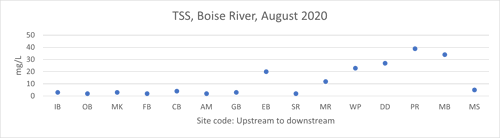
TSS is a measurement of the actual solid things that can be removed from water by a filter. Once scientists remove these solids, they can weigh them and find out how many suspended solids are in the water. The higher the number, the lower the water quality. The Boise River should be around 10 parts per million (ppm) or mg/L. The following data is a one-day sample collected by volunteers.
Total Nitrogen (TN)
TN is a measure of Nitrogen in the water. Nitrogen is a nutrient that is very abundant on earth. When there is a lot of nitrogen, it leads to excess algal growth and lower water quality. Ideally, TN levels in the Boise River are less than 5 ppm or mg/L.
All TN measurements in August 2020 on the Boise River for Watershed Watch were less than 5 mg/L. (no graph available)
Dissolved Oxygen (DO)
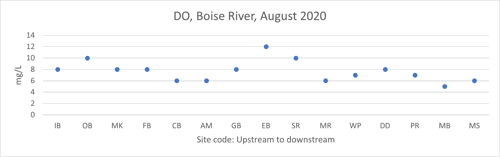
DO is a measurement of the oxygen in the water. The more oxygen, the more organisms in the water can live healthy lives. In the Boise River, an ideal DO level is 8 mg/L or higher. The following data is a one-day sample collected by volunteers.
pH
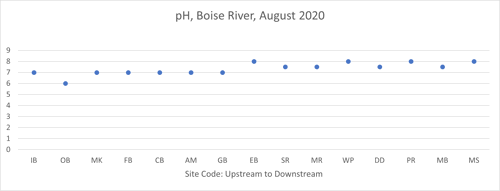
pH is a measurement of how acidic or how alkaline (basic) a liquid is. When measuring pH, scientists are measuring the concentration of hydrogen ions in the water. pH is measured on a scale. This scale goes from 0-14. If a solution has a measurement of 7, it is neutral. If it has a measurement higher than 7 it is alkaline. If it has a pH of less than 7 it is acidic. Ideally, water in the Boise River is close to 7. The following data is a one-day sample collected by volunteers.
Total Phosphorus (TP)
TP is a measurement of the Total Phosphorus in the water. Like TN, TP is a nutrient that leads to plant growth. Usually, the Boise River should have TP measurements less than 50 micrograms per liter (µg/L). The following data is a one-day sample collected by volunteers.
Lab Analysis Activities - Week 8
Activity 1: How much is 1 ppm or 1 mg/L?
Ppm and mg/L can be confusing when you hear them, but they are simple! They are both the same measurement so 1 ppm = 1 mg/L. Watch the following video to get an idea of how much a ppm or mg/l is:
You can find the video here
Activity 2: pH is important!
pH is something that we measure in solutions. You can find solutions with different pH measurements all around your house. Use online resources to find one solution in your house that is alkaline, one solution that is acidic, and one solution that is neutral.
Resources:
About the pH Scale - USGS (opens in a new tab)
About the pH Scale - Science News Explores (opens in a new tab)
Make certain that you are being safe with the different solutions. Ask an adult to help you determine if the solutions are safe for you to touch or smell.
Activity 3: Look at the data!
In the informational section of this lesson, we shared with you a lot of data about the Boise River and some of the information we received from the lab. Take a minute to review the data and answer the following question:
How does the Boise River water change as it flows downstream?
FINAL WATERSHED WATCH ACTIVITY
This is the last lesson in the Watershed Watch series. By watching the 8 videos and completing activities, you have now gotten a snapshot of the health of the Boise River! So, is the Boise River healthy?
Thank you to the following organizations for your participation in Watershed Watch!
City of Boise | City of Meridian | City of Caldwell | Idaho State Department of Agriculture | Idaho Department of Environmental Quality | Intermountain Bird Observatory | Partners for Clean Water | Veolia | United States Bureau of Reclamation | United States Geological Survey